
Communicating Pain
Michelle Failla’s research on pain in autistic people has surprising findings
by Melissa L. Weber
Michelle Failla's Masterminds talk on her research on pain in autistic people
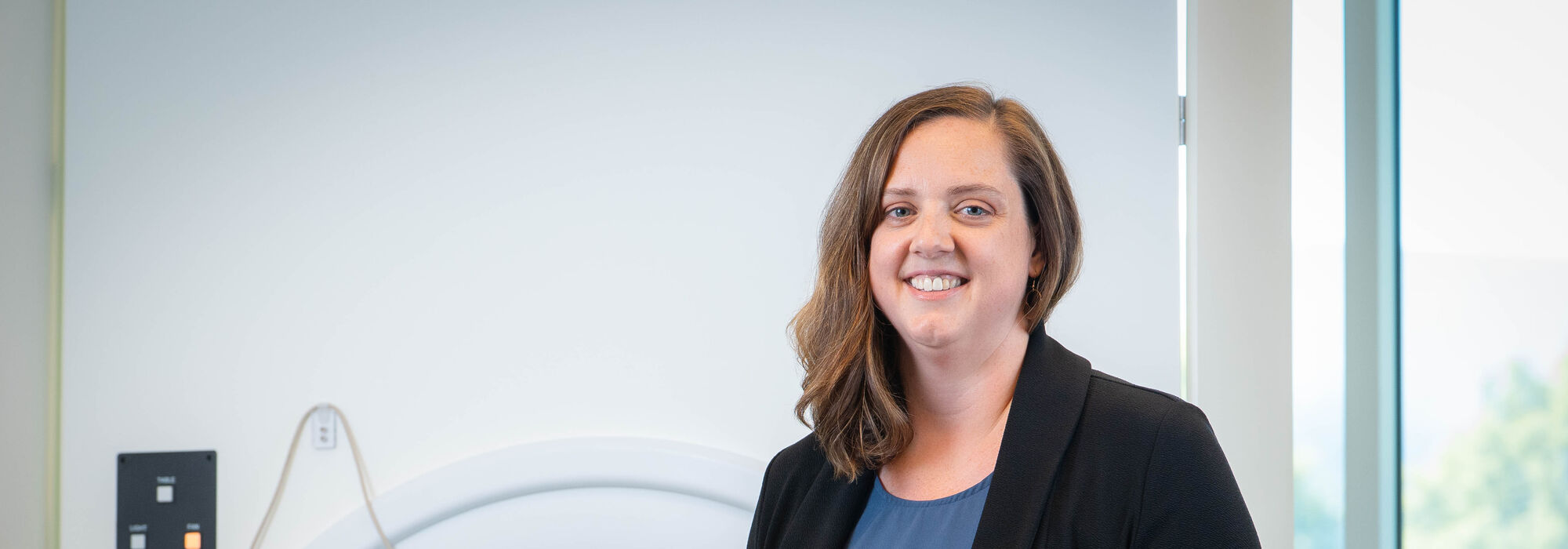
Michelle Failla, PhD, loves her unique position in the College of Nursing as a neuroscientist conducting research on pain in people who have differences in social communication. She especially appreciates working with nurses who can impact and improve patient care based on her research.
“Neuroscientists are often focused on the brain because that’s where their expertise lies; nurses focus on care for the whole person, because that’s how they prepare to use their expertise,” Failla explained. While neuroscientists may study pain as a brain function, nurses study it as a symptom or a communication tool. Many studies of pain have zeroed in on either brain function or patient care. Failla and her team work to change the “or” to an “and” to understand pain in both instances. “It’s revolutionary to think about the research in such a different way.”
For many years, some people in the healthcare community mistakenly assumed that autistic people were indifferent to pain, but advocates and researchers who worked within that community continually challenged that idea. Failla wanted to combine pain experiments with brain imaging that would help researchers and advocates understand how autistic people process and express pain.
“We’re discovering that autistic people may be more sensitive to pain [than non-autistic people],” Failla said. Differences in how autistic people communicate may cause their pain expression to look different.
Understanding brain processing
Failla described the complex learning process that takes place to help humans understand and stay safe in their environment. For example, babies learn that when they cry, someone will come to take care of them. That process of cause and effect is critically important because humans learn to make assumptions about their environment based on it.
“Every day, we all make predictions about our environment,” she said. “If we turn on the water faucet, we predict the temperature and pressure. Our brains do that prediction.”
Autistic people’s brains might not learn those causes and effects in the same way or might predict things differently. What might be a small difference in interpretation during development can become a big difference later.
Using pain to understand how the brain responds
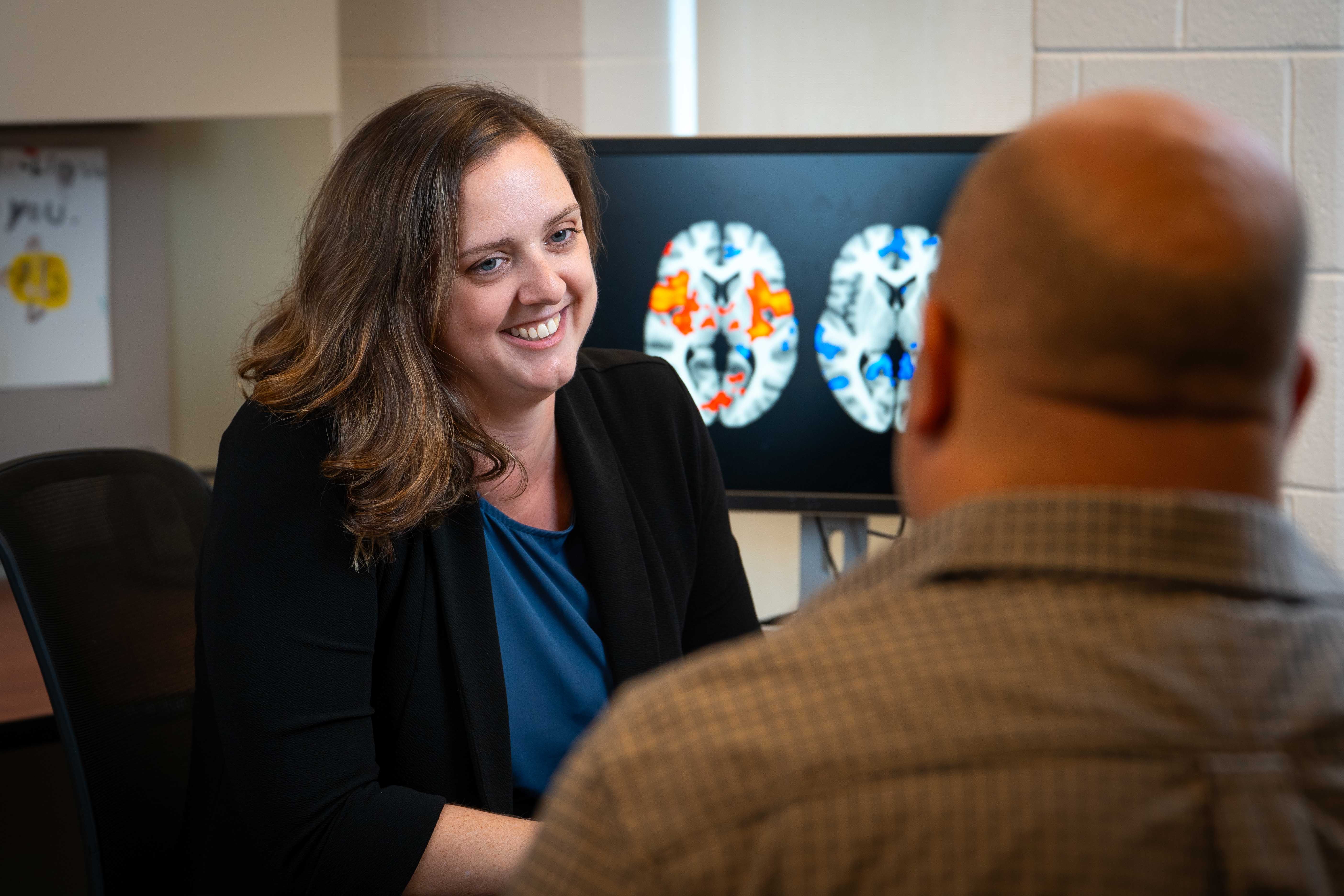
Failla studies sensory differences using mild pain during brain scans. Many previous studies have shown how neurotypical brains respond to pain. She had hoped that neuroimaging could be a tool to understand when autistic people are feeling pain, even if they couldn’t communicate it. However, the results were much more complex.
“What we found surprised us,” Failla said. “Something really different is happening. I want to understand how we can get a better sense of how autistic people are experiencing pain – the way their brains might process pain differently – and what that means for their everyday lives.”
She is working with autistic adults who can communicate verbally, with the goal of eventually understanding people who may not express themselves verbally.
“When you have an injury, pain is a biological signal,” she said. “But the experience of pain is a psychological state. I don’t like the idea of people struggling or suffering more because they can't communicate what's happening in their body."
Designing pain experiments
Failla works with autistic advocates when designing studies. She has engaged a board of advisors to ensure the research is conducted in a way that is comfortable for participants.
In one experiment, her lab uses a device called a thermode, which heats to different temperatures, up to the warmth of a coffee mug that’s too hot to hold, according to Failla.
“We design all experiments so participants are in the least amount of pain,” she said. “I try [the tests] myself to make sure I can get through them before I put anyone else through them.”
There are also additional safeguards to prevent too much pain or distress. Failla allows participants to feel the levels of heat they’ll experience in the experiment before it starts.
“If they don’t like it, we stop,” she said. “We don’t want anyone to have anxiety about it.”
In addition to heat, her research lab also uses cold-water tests, pressure tests, and plastic fibers to deliver short pricks as part of the pain measurement.
More training is needed to help patients
Failla’s research is funded by two active NIH grants to study pain in autistic adults. She has learned that many autistic adults, especially women, were diagnosed with a chronic pain condition prior to their autism diagnosis.
Clinicians try to help patients characterize their pain, but the typical scale which asks people to rate their pain “from 1 to 10” can be interpreted differently by different people. To understand someone’s pain, an understanding of the scale needs to be established.
“Pain management is a social communication issue,” she said. When we can’t directly ask someone about their pain, we might look for physical cues like facial expressions to determine how much pain another person is experiencing.
“Imagine trying to go to a hospital and communicate pain with them if you have difficulty communicating,” Failla said.
A combination of factors including chronic pain and how that pain is or is not communicated effectively can sometimes lead people to get tested for autism later in life, Failla said.
“You don’t know how things could get better once that door is opened,” she added.
Her work reveals different patterns in pain management and communication as autistic people age, along with gender differences. “Diagnostic criteria [for autism] was established on boys, not girls,” Failla said, and for children rather than adults. “We may have missed a lot of women.”
What, for Failla, is the best part about being at the College of Nursing? “The way nurses want to learn how to develop new trainings about caring for autistic patients,” Failla said. “They ask me, ‘How do we work with autistic people to make their patient experience better?’ And I’m in a unique position to help bring that awareness and to assist with training the next generation of nurses to provide more patient-centered care for autistic people.”

In this Issue
- Every Nurse is an Innovator
- New Accelerated Nursing Program
- Biomarker Summer Institute
- Communicating Pain
- Study Abroad in Cyprus
- Grants Roundup
- Buckeye Inspiration: Jackie Buck
- Student Life: Jen Huynh
- Impact of Giving: Carol and Roger McClure
- Farm Science Review
- Alumni in Action: Hannah Henry
- Simulating Dementia