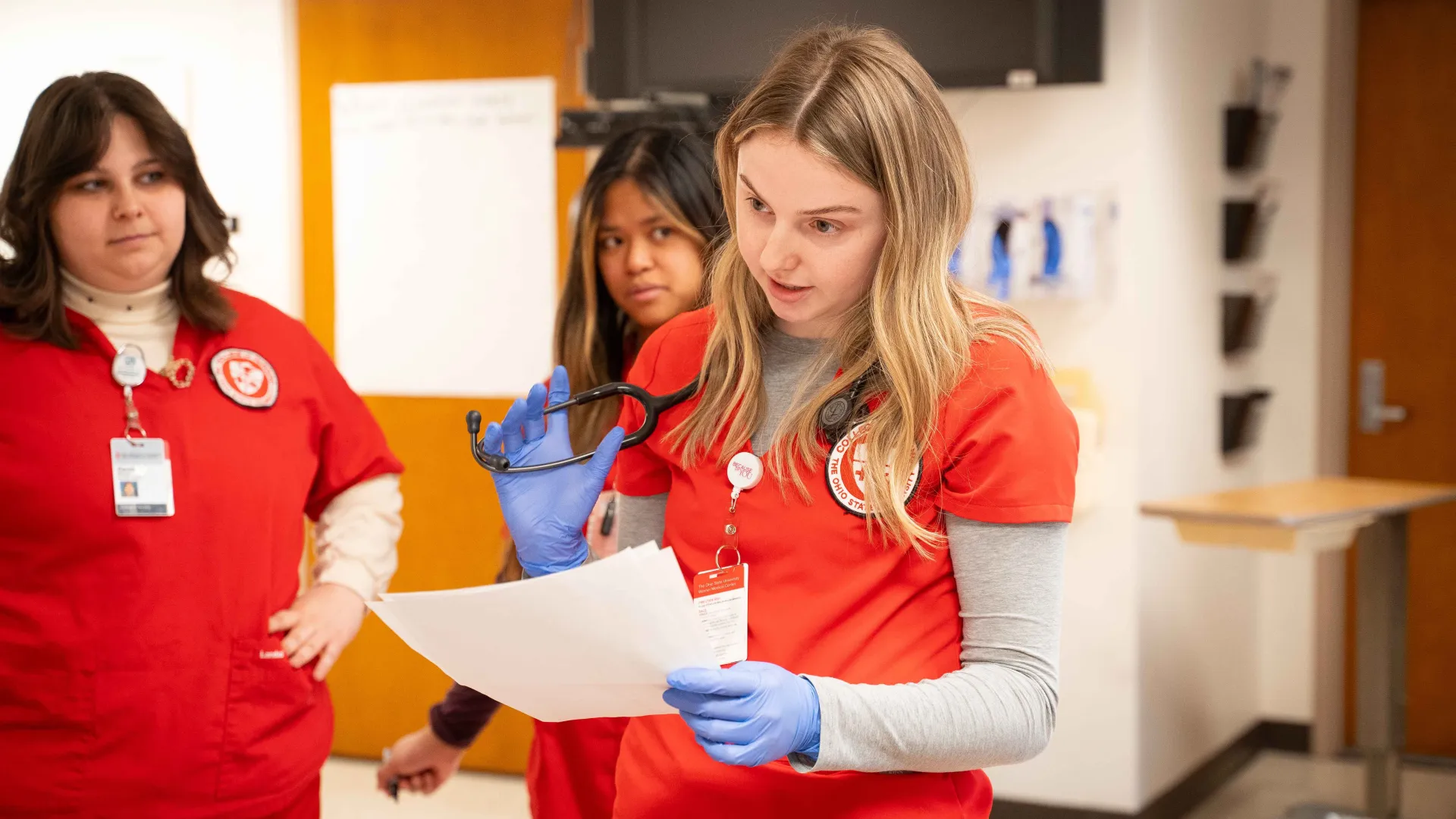
Bachelor of Science in Nursing
Join one of the nation’s top-ranked BSN programs and start your journey as a Buckeye nurse.
Program overview
Build the knowledge, clinical experience and confidence to deliver high-quality patient care.
Our Bachelor of Science in Nursing program is nationally ranked No. 1 among public institutions and No. 4 overall by US News & World Report for 2025. Here at Ohio State you will experience a blend of foundational coursework with hands-on clinical learning and immersive labs from expert faculty that will propel you into the healthcare field. The traditional BSN program encompasses prerequisite coursework and then three years of focused nursing coursework and clinical experiences.
Students can expect:
- Coursework consisting of at least 122 credit hours
- Early and ongoing clinical experience
- Faculty mentorship and academic advising
- Preparation for the NCLEX-RN licensure exam
Graduates are eligible to sit for the NCLEX-RN and pursue licensure as a registered nurse.
Explore your next steps
Connect with a recruitment coordinator for application assistance or schedule a meeting with an academic advisor to review transfer credits and get your questions answered.
We offer multiple pathways to help you earn your BSN. Each pathway has its own requirements and deadlines. Our three traditional pathways include:
Admission to the nursing major is required before enrolling in nursing courses. First-year and transfer students may begin as pre-nursing students if they meet admission criteria.
Transfer students should apply to the appropriate pathway based on their academic background and these students can review course equivalencies using university resources.
Prerequisite courses may be completed at Ohio State or another accredited institution.
Our curriculum prepares you to deliver safe, effective and evidence-based care in a rapidly changing healthcare environment.
You’ll complete one year of prerequisite coursework followed by three years in a structured, lock-step nursing curriculum. Once admitted to the nursing major, your course sequence is set to ensure consistent progression.
You’ll receive:
- A personalized curriculum plan
- Academic advising and support
- Guidance on course sequencing and progression
Course progression may vary based on:
- Transfer credit
- AP or test credit
- Placement scores
- Academic performance
General education requirements for BSN students entering the university after August 2022
- Nursing 2271 Foundational Knowledge for Nursing Practice I (4)
- Nursing 2451 Nursing Pathophysiology and Pharmacology I (3)
- Nursing 2200 Art of Professional Nursing I (2)
- Nursing 2500 Introduction to Social Justice and Health Policy (1)
- Nursing 5115 MINDSTRONG (1)
- Nursing 2272 Foundational Knowledge for Nursing Practice II (4)
- Nursing 2452 Nursing Pathophysiology and Pharmacology II (3)
- Nursing 2201 Art of Professional Nursing II (2)
- Nursing 2782 Foundational Principles of EBP and Nursing Science (2)
- Nursing 3271 Nursing Care of Adults and Older Adults I (4)
- Nursing 3280 Nursing Care of Women and Families During Reproductive Transitions (4)
- Nursing 3460 Motivational Interviewing (1)
- Nursing 3272 Nursing Care of Adults and Older Adults II (4)
- Nursing 3260 Nursing Care of Children and their Families (4)
- Nursing 3780 Evidence-based Nursing Care for Patients in Palliative and end of life Care (2)
- Nursing 3240 Population Health Local to Global (3)
- Nursing 4241 Synthesis of Determinants of Health to Address Population Health Outcomes (4)
- Nursing 4341 Nursing Clinical Judgement in the Care of Psychiatric and Mental Health Conditions (4)
- Nursing 4401 Innovative Strategies in Leadership and Systems-based Practice (2)
- Nursing 4402 Synthesis of Nursing Practice and Patient Care in Complex Healthcare Systems (2)
- Nursing 4590 Practicum for the Utilization of Nursing Clinical Judgement (6)
- Nursing 4310 Science of Wellness and Self-care (1)
- Nursing 4520 Utilization of Information and Healthcare Technology to Drive Decision Making in Nursing (1)
- Statistics 1350 (3 CH), 1450 (3 CH) or 2450 (3 CH)
- Microbiology 4010 (3 CH)
- Human Nutrition:
- Students admitted to the direct admission pathway are expected to take Human Nutrition 2200 (2 CH)
- All other students seeking admission to the nursing program can take Human Nutrition 2200 (2 CH) or 2410 (4 CH)
- HW 2102 Optimizing Personal Health, Happiness & Well-being
- HW 2210 Dimensions of Wellness and Resilience
- HW 2220 Wellness in Chronic Conditions I
- HW 3220 Health Promotion Strategies for People with Chronic Conditions
- HW 3230 Coaching for Health Improvement
- NRSADVN 3113 RN Practice in Primary Care and Substance Use Disorder
- NRSADVN 3114 Care Coordination and Transition in Care
- NRSADVN 3115 Telehealth Assessment and Management in Primary Care
- NRSADVN 3116 Evidence-Based Health Coaching in Interprofessional Practice
- NRSADVN 3117 RN Practice in Primary Care
- Nursing 2781H Honors Research Methods*
- Nursing 2890.01H Sophomore Honors Seminar 1*
- Nursing 2890.02H Sophomore Honors Seminar 2*
- Nursing 3200 Failure to Rescue
- Nursing 3431 Global Options Nursing Capstone
- Nursing 3890.01H Junior Honors Seminar 1*
- Nursing 3890.02H Junior Honors Seminar 2*
- Nursing 4110 Nursing Process in the Perioperative Setting
- Nursing 4150 Epidemiology Concepts in Nursing and Global Healthcare
- Nursing 4890.01H Senior Honors Seminar 1*
- Nursing 4890.02H Senior Honors Seminar 2*
*This option is only available to students in the BSN Honors Program admitted Autumn 2024 and after.
University Honors Program
Incoming pre-nursing students with strong high school academics and high ACT/SAT scores can apply to the University Honors Program.
College of Nursing BSN Honors program
The College of Nursing provides various research opportunities to our undergraduate students. The BSN Honors program focuses on producing high-caliber nurses, researchers and health professionals who lead in innovation, wellness promotion, policy change and improvement in health outcomes across diverse communities.
Traditional undergraduate students may apply at the end of their first year after being accepted into the nursing major. Admission decisions and faculty mentor assignments are made by the Honors program subcommittee.
Students who have previously held honors status at either a university or college level must be enrolled in the Honors program to retain honors status and to graduate with distinction.
BSN Honors students will:
- Develop a partnership with an assigned faculty mentor to learn more about nursing research
- Conduct a research project under the direction of their faculty mentor, write a thesis and present results at a local research event
- Graduate with Honors Research Distinction in Nursing
- Have the opportunity for early class registration
- Complete courses as outlined in Honors Curriculum and Course Progression
To practice as a registered nurse, graduates must pass the NCLEX-RN licensure exam.
As per the Ohio Revised Code, eligibility requirements include:
- Completion of an approved nursing program
- Submission of fingerprints to the Bureau of Criminal Identification and Investigation for a background check
- Compliance with state licensing regulations
Certain criminal convictions may affect eligibility for licensure.
Ohio State’s BSN program prepares students for licensure in Ohio. Students planning to practice outside Ohio should review state-specific requirements.
Completion of the program does not guarantee licensure or employment.
We support our students in pursuing their personal and professional success through the philosophy of LIVE WELL. BSN graduates will be prepared to:
- Lead: Embody the values and leadership abilities of a professional nurse across the lifespan in a variety of settings
- Innovate: Serve as an innovative nurse who makes meaningful and unique contributions toward wellness promotion, disease prevention and management and population health improvements
- Vision: Practice with vision and leverage one’s own career to transform healthcare to ultimately improve quality and safety
- Execute: Execute clinical reasoning and evidence-based decision making to practice with the full extent of licensure
- Wellness-focused: Apply a holistic approach to optimal health and well-being for self, individuals and populations
- Evidence-based: Implement best practices consistently while fostering an evidence-based practice culture
- Lifelong learning: Embrace life-long learning to transform health and improve lives
- Lights for the world: Exemplifying the spirit of caring and service
Other pathways to a BSN
FAQ
No. A CNA/STNA license is not required, but you may choose to obtain one for work experience.
Yes. Transfer credit is evaluated after admission. You can explore potential equivalencies using university transfer tools, but final decisions are made during the official review process.
Most clinical experiences occur on or near Ohio State’s medical campus. Some placements may require short travel to nearby partner hospitals.
Yes. All graduates are eligible to sit for the NCLEX-RN.
Yes, but flexibility is important. Clinical schedules are fixed and cannot be adjusted for work.
Yes. Students may pursue minors or certificates if they fit within the program schedule.
Yes. Study abroad opportunities are available during breaks or summer terms to avoid conflicts with required coursework.
Contact
The baccalaureate degree program in nursing at The Ohio State University College of Nursing is accredited by the Commission on Collegiate Nursing Education, 655 K Street NW, Suite 750, Washington, DC 20001, 202-887-6791.