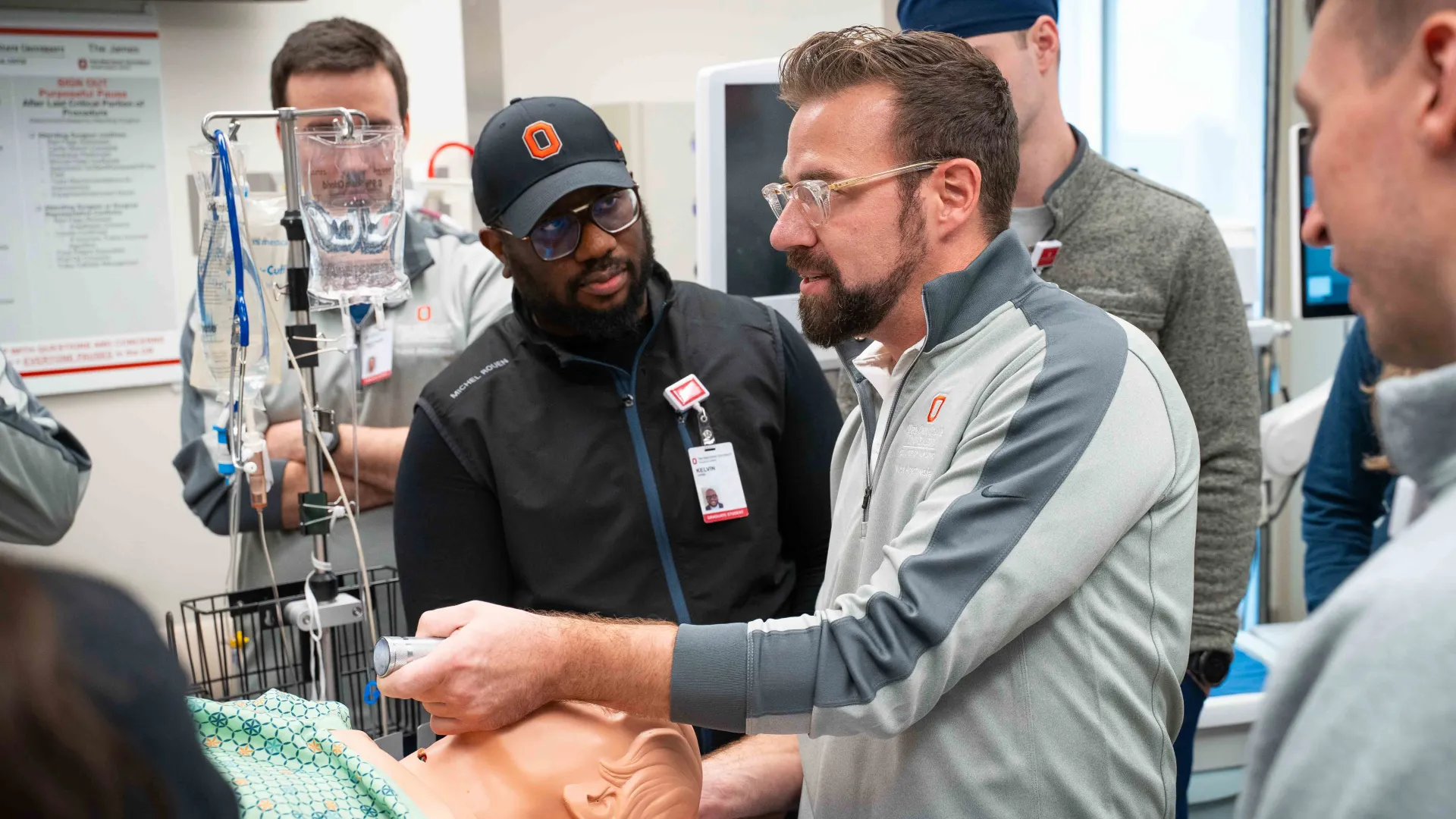
Nurse Anesthesia Doctor of Nursing Practice (DNP)
Ohio State’s Nurse Anesthesia DNP program prepares advanced practice nurses to become Certified Registered Nurse Anesthetists (CRNAs) with the expertise to deliver safe, evidence-based anesthesia care across diverse patient populations and clinical settings.
Nurse anesthesia education at Ohio State
At Ohio State, nurse anesthesia students train within one of the nation's leading academic health systems - where innovation, research and collaboration thrive. Guided by world-class faculty and dedicated mentors, students gain clinically rigorous, evidence-based training preparing them to lead in today’s healthcare environment.
Developing advanced knowledge in anesthesia practice, pharmacology, physiology, patient monitoring and perioperative care students are prepared through rigorous clinical education, simulation experiences and interdisciplinary collaboration.
What is a CRNA?
Certified Registered Nurse Anesthetists (CRNAs) are advanced practice registered nurses (APRNs) specializing in anesthesia care. Their role is highly skilled and critical to patient safety administering anesthesia for surgical, obstetric, diagnostic and therapeutic procedures.
They provide pain management, patient monitoring, collaborative practice with surgeons, anesthesiologists as well as other healthcare professionals. CRNAs practice across a variety of healthcare environments, including hospitals, outpatient surgery centers, pain management clinics and rural or underserved areas.
Admission requirements for the Nurse Anesthesia DNP program
- Bachelor of Science (BSN) or a Master of Science in Nursing
- Must be from a program accredited through CCNE, ACEN or CNEA
- Must be conferred by May 15, prior to beginning enrollment
- International applicants must hold the equivalent BSN degree or higher from a regionally accredited institution.
- All transcripts must undergo a course-by-course credential evaluation by an approved evaluation agency to verify program equivalency and calculate a GPA on a 4.0 scale
- Active, unencumbered RN license in the state where you practice
- Cumulative GPA of 3.0 or higher in the most recent relevant degree
- Applicants with lower GPAs may still be considered
- Minimum one year of full-time critical care experience (or part-time equivalent) as a registered nurse, completed within the past two years and met by the application deadline.
- Must be in a critical care setting in the United States, its territories or a U.S. military hospital abroad.
- Must demonstrate independent decision-making skills and the ability to manage unstable patients using advanced monitoring techniques, based on physiological and pharmacological knowledge.
- Qualifying experience includes management of invasive hemodynamic monitoring (e.g., pulmonary artery, central venous pressure, arterial catheters), mechanical ventilation, cardiac assist devices and vasoactive infusions.
- Critical care areas include settings where these skills are routinely applied. Applicants with other experience may be considered if they can demonstrate equivalent competencies.
- Minimum cumulative physical science GPA of 3.2 or greater in the following courses
- Biology (anatomy and physiology courses accepted)
- Chemistry (general, organic, inorganic or biochemistry courses accepted)
- Microbiology
Applications that do not meet these minimum eligibility requirements, including the prerequisite coursework and science GPA requirements will not advance for review.
Program length
- 36 months full-time study, including summers
Credit hours
- 106
Delivery format
- Online synchronous coursework
- In-person skills sessions and simulation seminars
- On-campus experiences throughout the curriculum, pre-scheduled for student planning
- Required on-campus visits include various skills weeks in year 1 and simulation days in years 2 and 3
Clinicals
- All sites are in Ohio
Sample schedule
Year 1
Autumn: 17 credit hours
- Pathophysiology of Altered Health States (5)
- Mindstrong (1)
- Foundations of Evidence Based Practice (2)
- Method/Measurement for the Evaluation for Evidence-Based Nursing (2)
- Scientific Foundations of Nurse Anesthesia Practice (3)
- Pharmacology for Nurse Anesthesia Practice (4)
Spring: 16 credit hours
- Advanced Health Assessment (4)
- Advanced Practice Pharmacology for Nurse Anesthetists (4)
- Advanced Physiology & Pathophysiology for Nurse Anesthesia Practice I (5)
- Foundations of Nurse Anesthesia Practice* (3)
Summer: 14 credit hours
- Clinical Reasoning with Diagnostic Methods for Advanced Nursing Practice (2)
- Evidence Based Quality Improvement for the DNP (2)
- Implementation and Evaluation of Evidence Based Practice (2)
- Advanced Physiology and Pathophysiology for Nurse Anesthesia Practice II (4)
- Applied Clinical Skills for Nurse Anesthesia Practice (2 didactic, 2 lab)
Year 2
Autumn: 15 credit hours
- Leadership, Role and Collaboration for the DNP (3)
- Nursing Policy for Doctoral Nursing Practice (2)
- DNP Professional Seminar: Scholarly Writing I (1)
- Advanced Principles for Nurse Anesthesia Practice I (4)*
- Nurse Anesthesia Clinical Practice I (5)**
Spring: 15 credit hours
- Healthcare Economics and Finance for the Doctor of Nursing Practice (2)
- DNP Systems Application I (1 didactic, 1 immersion)
- Health Promotion, Theory and Population Health (2)
- Advanced Principles for Nurse Anesthesia Practice II (4)*
- Nurse Anesthesia Clinical Practice II (5)**
Summer: 9 credit hours
- Health Informatics and Technology for the DNP (2)
- DNP Systems Application II (1 didactic, 1 immersion)
- Nurse Anesthesia Clinical Practice III (5)**
Year 3
Autumn: 9 credit hours
- DNP Professional Seminar: Scholarly Writing II (1)
- DNP Final Document Project I (1)
- DNP Systems Application III (1 didactic, 1 immersion)
- Nurse Anesthesia Clinical Practice IV (5)**
Spring: 8 credit hours
- DNP Final Document Project II (1)
- DNP Systems Application IV (1 didactic, 1 immersion)
- Nurse Anesthesia Clinical Practice V (5)**
Summer: 6 credit hours
- Advanced Practice Nursing: Final Professional Seminar (1)
- Nurse Anesthesia Clinical Practice VI (5)**
*Courses may include an in-person seminar, simulation and/or skills session in addition to distance education.
**Clinical course that will include an in-person seminar, simulation and/or skills session in addition to clinical practicum and distance seminar/integration.
Clinical sites are continuously evaluated and added to support student and program needs. All current sites are within Ohio, and students rotate through multiple sites each semester to broaden experience and meet required specialty case mix.
Locations include:
- The Ohio State University Wexner Medical Center
- University Hospital
- East Hospital
- Eye and Ear Institute
- Richard M. Ross Heart Hospital
- James Cancer Hospital
- Outpatient Care New Albany
- Outpatient Care Dublin
- ProMedica Toledo Hospital
- Nationwide Children’s Hospital
- Adena Regional Medical Center
- Mercy Health Springfield Regional Medical Center
- Holzer Hospital Gallipolis
- Mercy Health Tiffin Hospital
- Blanchard Valley Health System
- Mercy Health St. Rita's Medical Center
- Marietta Memorial Hospital
Applicants can track their application status through their Applicant Center. Allow up to five business days for material status updates to be reflected.
Graduate transfer applicants can check their status by emailing nursing@osu.edu.
- Deadline
- The application and all required materials must be submitted by 11:59 p.m. ET on the posted deadline.
- Second-round interview
- For a limited number of applicants. Those selected will receive this notice via email by the end of October.
- If selected, the second-round interview will take place virtually (via Zoom) for 30 minutes in late October.
- Decision
- Mid-November
- Applicants are notified through their Applicant Center and/or by email from the Office of Graduate and Professional Admissions.
- Accept offer
- Four weeks post decision
- Students who do not respond to their offer of admission by the deadline will have their offer cancelled.
How to apply to the Nurse Anesthesia DNP program
Apply online through the Office of Graduate and Professional Admissions. Pay the $60 application fee at the time of submission.
Submit official transcripts from all colleges and universities you’ve attended at the undergraduate and graduate levels. This includes coursework taken in high school that appears as transfer credit. Ohio State transcripts are not required.
- Official transcripts must be sent directly by the institution via mail or electronic transfer:
- Email: gpadocs@osu.edu
- Mail:
The Ohio State University
Graduate Admissions Office
P.O. Box 182004
Columbus, OH 43218-2004
- You may upload a copy of an official transcript with your application; these are considered unofficial but sufficient for application review.
- Web-based grade reports or other online documents are not acceptable. If admitted, official transcripts must be sent directly from your institution(s).
- For questions or details, contact the Graduate and Professional Admissions Office at 614-292-9444 or gpadmissions@osu.edu.
- Format your resume or CV as you would for a job application.
- Include education, professional experience, community service, volunteer work, publications, presentations, research, and leadership activities.
Submit your document with your application via the admissions uploader.
Upload a statement describing your professional experience, career goals and alignment with the goals of the DNP Nurse Anesthesia program.
- Keep your statement no longer than three single-spaced pages.
- The statement should demonstrate your writing skills and show alignment between your goals and those of the program.
- Address the following:
- Include rationale for selecting the Nurse Anesthesia DNP program and how completing the program will assist you in achieving your professional and educational goals.
- What specifically are your academic and career goals for which the DNP program will prepare you best?
- How have your life experiences prepared you for being a doctoral-prepared nurse?
- Why are you seeking education in the DNP program at this time in your career?
- Complete a recorded online interview through HireVue after submitting your application.
- The interview includes questions about your interests and goals in nursing and the Nurse Anesthesia DNP program.
- You may complete the interview at any time during the application window, but it must be completed before the application deadline.
Instructions for the Nurse Anesthesia DNP recorded video interview.
- Provide the names and email addresses of three individuals who can speak to your clinical and leadership abilities.
- After you submit your application, recommenders will receive an email with a link and instructions to upload their letters.
- Submit your application early so recommenders have enough time to respond.
- Letters should come from people familiar with your academic ability, professional experience and potential for graduate study.
- Give your recommenders your intended degree, specialty, and purpose and goals statement.
Test of English proficiency
Learn more about details regarding what English proficiency tests are acceptable, the scores required and how to submit.
Credential evaluations
If you completed the equivalent of a bachelor’s degree or higher at an institution outside of the United States, you must submit a course-by-course credential evaluation that verifies U.S. degree equivalency and includes a cumulative Grade Point Average (GPA) on a 4.0 scale.
The evaluation must be completed by an approved credential evaluation agency and sent directly to the university by the agency. Our preferred agency is TruMerit (formerly CGFNS International) as TruMerit credential evaluations are also required by the Ohio Board of Nursing for RN licensure.
You can find additional information on Ohio State's Graduate and Professional Admissions page.
We will also accept evaluations from the following approved agencies:
- World Education Services (WES) SpanTran (The Evaluation Company)
- Educational Credential Evaluators (ECE)
- International Education Evaluations (IEE)
- Josef Silny & Associates (JS&A)
- International Education Research Foundation (IERF)
- International Consultants of Delaware (ICD)
The course-by-course credential evaluation must include:
- Verification of U.S. degree equivalency
- A list of completed coursework with credit hours and grades
- Calculation of a cumulative GPA on a 4.0 scale
If you are currently or previously enrolled in a graduate program at Ohio State, you are considered a Graduate Intra-University Transfer Student. Select the application for current or former Ohio State students when you apply.
In addition to the online application, you must submit a supplemental application.
Choose preferred format:
- MS Word Document: Supplemental Nurse Anesthesia DNP application
- PDF: Supplemental Nurse Anesthesia DNP application
Within 24 to 48 hours of submitting your application, you will receive an email from the College of Nursing with a link to a required survey to report prior science coursework and grades. You must submit this to complete your application.
Applicants must submit all application materials by 11:59 p.m. ET on the deadline to be considered for admission.
Contact
FAQ
For Nurse Anesthesia specialty track applicants, a minimum of one-year full-time, recent (within two years of application) work experience, or its part-time equivalent, as a registered nurse in a critical care setting is required by the COA. Competitive applications will have at least one year of this experience.
Through this experience, you must have developed as an independent decision maker capable of using and interpreting advanced monitoring techniques based on knowledge of physiological and pharmacological principles. Critical care experience must be obtained in a critical care area within the United States, its territories, or a US military hospital outside of the United States. During this experience, the registered professional nurse has developed critical decision making and psychomotor skills, competency in patient assessment, and the ability to use and interpret advanced monitoring techniques.
A critical care area is defined as one where, on a routine basis, the registered professional nurse manages one or more of the following: invasive hemodynamic monitors (e.g. pulmonary artery, central venous pressure, and arterial catheters), cardiac assist devices, mechanical ventilation, and vasoactive infusions.
Examples of critical units may include but are not limited to: surgical intensive care, cardiothoracic intensive care, coronary intensive care, medical intensive care, pediatric intensive care, and neonatal intensive care. Those who have experiences in other areas may be considered provided they can demonstrate competence with managing unstable patients, invasive monitoring, ventilators, and critical care pharmacology.
The decision to work during the program is an individual one but is not recommended. As the program is only offered in a full-time format, the number of credit hours each semester varies but is as high as 15+ credits per semester.
Once the clinical component begins in the third semester, students are in class one full day and in the operating room four full days with care plans and coursework that must be completed in the evenings and on weekends. The workload of the program makes it very difficult to work. Nurse Anesthesia specialty track guidelines also restrict clinical practice before and after a program-related clinical shift, requiring at least eight (8) hours of rest between clinical responsibilities.
No, students may not organize their own clinical sites. New clinical sites are being continually evaluated by program leadership and must be approved by COA.
No. Clinical site rotations are at the discretion of the program leadership and are determined based on distributing clinical experiences so that all students complete required case numbers and experiences. The program cannot accommodate individual clinical rotation requests.
All clinical sites are located throughout the state of Ohio. Most students will rotate to all sites, and students should plan to relocate to Ohio no later than the summer term (third semester) of their first year.
Ohio State has a specific course in regional anesthesia, including in-depth skills and simulation labs. Students traditionally exceed the COA requirement for regional anesthesia experiences.
The program does not offer a stipend.
Most financial aid is in the form of student loans. Learn more about financial aid and resources to support the cost of your education.
There are University scholarships and AANA scholarships available. Most financial aid is in the form of student loans. Learn more about financial aid and resources to support the cost of your education.
- University scholarships
- AANA scholarships
- Learn more about financial aid
Learn more about tuition and fees.
A current Ohio nursing license is required by August 1 prior to beginning the program, though it is not needed for consideration to the program.
Current ACLS and PALS certifications are not required to apply but successful completion is required by the student’s second semester prior to entering the clinical environment. ACLS and PALS maintenance certification is required for the duration of the program.
Students are required to obtain a student malpractice insurance policy by the second semester prior to entering the clinical environment. Maintenance if this policy is required for the duration of the program. CRNA Malpractice Insurance Coverage | AANA Insurance Services has more information about the preferred student malpractice carrier.
Accreditation
The Nurse Anesthesia DNP program at The Ohio State University College of Nursing is accredited by the Council on Accreditation of Nurse Anesthesia Educational Programs.
Contact information:
10275 W. Higgins Rd., Suite 906
Rosemont, IL 60018-5603
224-275-9130
coacrna.org