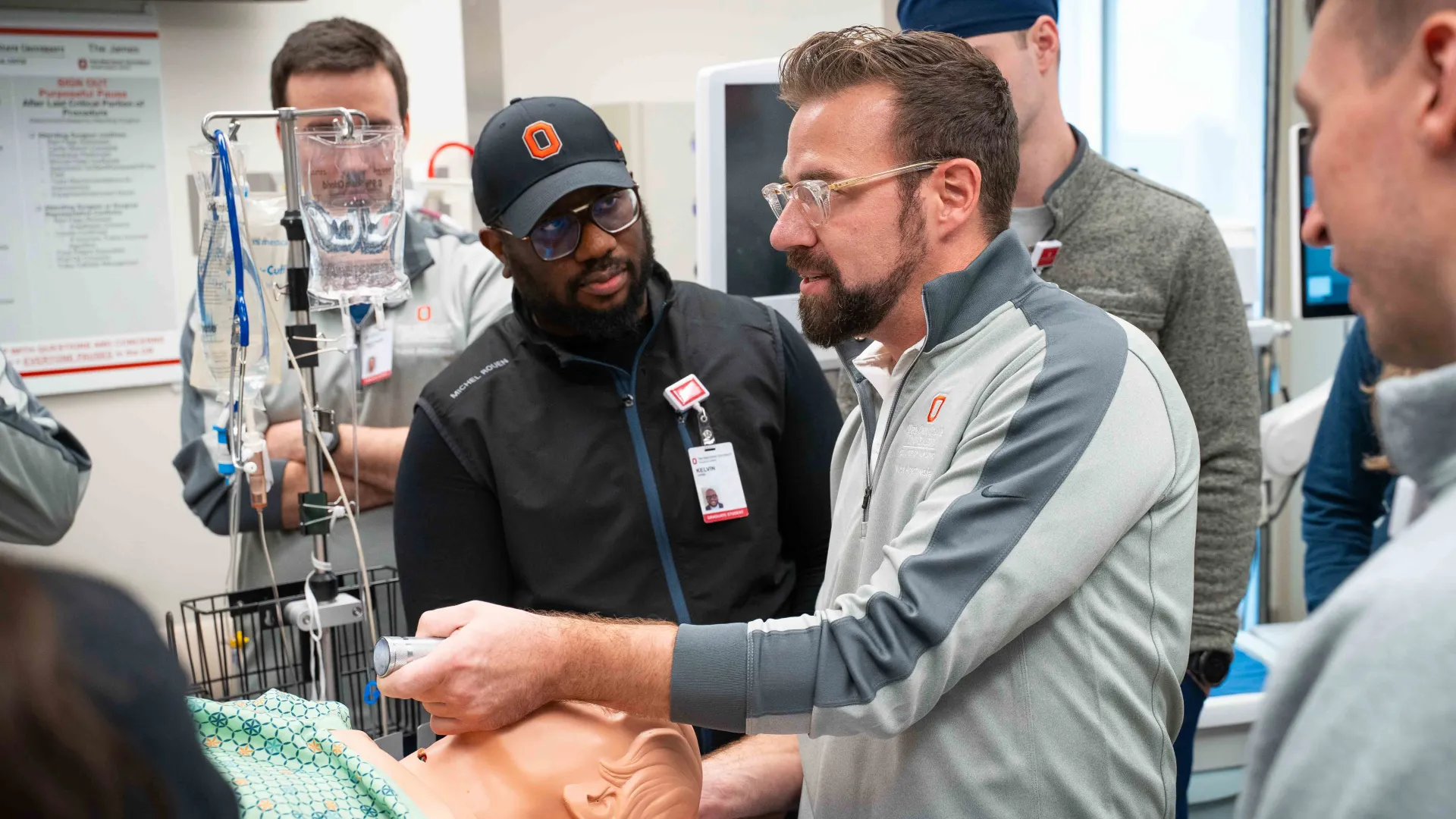
Nurse Anesthesia
Use your expertise to provide safe and effective anesthesia care to your patients.
Program overview
The Nurse Anesthesia specialty track is in our highly ranked BSN to DNP program and launched its first cohort in Autumn 2024. Certified Registered Nurse Anesthetists (CRNAs) are advanced practice registered nurses (APRNs) who specialize in anesthesia care. Their role is highly skilled and critical to patient safety administering anesthesia for surgical, obstetric, diagnostic and therapeutic procedures. They provide pain management, patient monitoring, collaborative practice with surgeons, anesthesiologists as well as other healthcare professionals. CRNAs practice in a variety of settings including hospitals, outpatient surgery centers, pain management clinics and rural or underserved areas.
At Ohio State, you’ll be part of one of the nation’s most comprehensive health sciences centers—where innovation, research and collaboration thrive. Guided by world-class faculty and dedicated mentors, you’ll gain clinically rigorous, evidence-based training that prepares you to lead in today’s healthcare environment. You will build skills across diverse settings—from community-based primary care agencies to The Ohio State University Wexner Medical Center’s renowned teaching hospitals. Along the way, you’ll benefit from hands-on experiences, interdisciplinary collaboration with healthcare professionals, and the support of expert preceptors committed to your growth.
You can complete this specialty through our BSN to DNP program.
Time to degree
- 36 months full-time study, including summers
Credit hours
- 106
Delivery format
- Online synchronous coursework
- In-person skills sessions and simulation seminars
- On-campus experiences scheduled throughout the curriculum for student planning
- Required intermittent campus visits: skills weeks in year 1; simulation days in years 2–3 for clinical courses
Clinicals
- All sites are in Ohio
Sample schedule
Year 1
Autumn: 16 credit hours
- Pathophysiology of Altered Health States (4)
- MINDSTRONG (1)
- Foundations of Evidence Based Practice (2)
- Method/Measurement for the Evaluation for Evidence-Based Nursing (2)
- Scientific Foundations of Nurse Anesthesia Practice (3)
- Pharmacology for Nurse Anesthesia Practice (4)
Spring: 16 credit hours
- Advanced Health Assessment (4)
- Advanced Pharmacology in Nursing (4)
- Advanced Physiology & Pathophysiology for Nurse Anesthesia Practice I (5)
- Foundations of Nurse Anesthesia Practice* (3)
Summer: 12 credit hours
- Clinical Reasoning with Diagnostic Methods for Advanced Nursing Practice (2)
- Evidence Based Quality Improvement for the DNP (2)
- Implementation and Evaluation of Evidence Based Practice (2)
- Advanced Physiology & Pathophysiology for Nurse Anesthesia Practice II (4)
- Introduction to Clinical Anesthesia (2)*
Year 2
Autumn: 15 credit hours
- Leadership, Role, and Collaboration for the DNP (3)
- Nursing Policy for Doctoral Nursing Practice (2)
- DNP Professional Seminar: Scholarly Writing I (1)
- Advanced Principles for Nurse Anesthesia Practice I (4)*
- Nurse Anesthesia Clinical Practice I (5)**
Spring: 13 credit hours
- Healthcare Economics and Finance for the Doctor of Nursing Practice (2)
- Health Promotion, Theory, and Population Health (2)
- Advanced Principles for Nurse Anesthesia Practice II (4)*
- Nurse Anesthesia Clinical Practice II (5)**
Summer
- Health Informatics and Technology for the DNP (2)
- DNP Systems Application I (2)
- 1 didactic, 1 clinical Nurse Anesthesia Clinical Practice III (5)**
- Total credits: 9
Year 3
Autumn: 8 credit hours
- DNP Professional Seminar: Scholarly Writing II (1)
- DNP Systems Application II (2)
- Variable credit 1 didactic/1-4 clinical
- Nurse Anesthesia Clinical Practice IV (5)**
Spring: 8 credit hours
- DNP Final Document Project I (1)
- DNP Systems Application III (2)
- Nurse Anesthesia Clinical Practice V (5)**
Summer: 9 credit hours
- DNP Final Document Project II (1)
- DNP Systems Application IV (2)
- Advanced Practice Nursing: Final Professional Seminar (1)
- Nurse Anesthesia Clinical Practice VI (5)**
*Courses may include an in-person seminar, simulation and/or skills session in addition to distance education.
**Clinical course that will include an in-person seminar, simulation and/or skills session in addition to clinical practicum and distance seminar/integration.
Clinical sites are continuously evaluated and added to support student and program needs. All current sites are within Ohio, and students rotate through multiple sites each semester to broaden experience and meet required specialty case mix.
Locations include:
- The Ohio State University Wexner Medical Center
- University Hospital
- East Hospital
- Eye and Ear Institute
- Richard M. Ross Heart Hospital
- James Cancer Hospital
- Outpatient Care New Albany
- Outpatient Care Dublin
- ProMedica Toledo Hospital
- Nationwide Children’s Hospital
- Adena Regional Medical Center
- Mercy Health Springfield Regional Medical Center
- Clinton Memorial Hospital
- Holzer Hospital Gallipolis
- Mercy Health Tiffin Hospital
- Blanchard Valley Health System—Findlay Surgery Center
Nurse Anesthesia applications are only accepted during round one on the BSN to DNP application cycle. Track your application status via the Applicant Center. Allow up to five business days for material statuses to update. Graduate transfer applicants can check their status by emailing nursing@osu.edu.
- Deadline
- Submit your application and all required materials by the posted deadline.
- A limited number of applicants will be offered a second-round interview and move forward with the admission process.
- Interview
- A limited number of DNP applicants to the Nurse Anesthesia specialty track will be offered a second-round interview. If selected, the second-round interview will take place virtually (via Zoom) for 30 minutes in early December.
- If you are selected for a second-round interview you will receive this invitation via email. Not all applicants will move forward and be offered the chance to participate in a second-round interview.
- Decision
- December
- You will be notified through your Applicant Center and/or by email from the Office of Graduate and Professional Admissions.
- Accept offer
- Four weeks post decision
- Students who do not respond to their offer of admission by the deadline will have their offer cancelled.
- Register for courses by July 15
- Failure to adhere to this requirement will result in your withdrawal from our DNP Program and admission of a waitlist candidate.
- Admitted students must communicate any extenuating circumstances with the Nurse Anesthesia director by July 15.
FAQ
For Nurse Anesthesia specialty track applicants, a minimum of one-year full-time, recent (within two years of application) work experience, or its part-time equivalent, as a registered nurse in a critical care setting is required by the COA. Competitive applications will have at least one year of this experience.
Through this experience, you must have developed as an independent decision maker capable of using and interpreting advanced monitoring techniques based on knowledge of physiological and pharmacological principles. Critical care experience must be obtained in a critical care area within the United States, its territories, or a US military hospital outside of the United States. During this experience, the registered professional nurse has developed critical decision making and psychomotor skills, competency in patient assessment, and the ability to use and interpret advanced monitoring techniques.
A critical care area is defined as one where, on a routine basis, the registered professional nurse manages one or more of the following: invasive hemodynamic monitors (e.g. pulmonary artery, central venous pressure, and arterial catheters), cardiac assist devices, mechanical ventilation, and vasoactive infusions.
Examples of critical units may include but are not limited to: surgical intensive care, cardiothoracic intensive care, coronary intensive care, medical intensive care, pediatric intensive care, and neonatal intensive care. Those who have experiences in other areas may be considered provided they can demonstrate competence with managing unstable patients, invasive monitoring, ventilators, and critical care pharmacology.
The decision to work during the program is an individual one but is not recommended. As the program is only offered in a full-time format, the number of credit hours each semester varies but is as high as 15+ credits per semester.
Once the clinical component begins in the third semester, students are in class one full day and in the operating room four full days with care plans and coursework that must be completed in the evenings and on weekends. The workload of the program makes it very difficult to work. Nurse Anesthesia specialty track guidelines also restrict clinical practice before and after a program-related clinical shift, requiring at least eight (8) hours of rest between clinical responsibilities.
You can apply to take up to ten credit hours as a non-degree student without matriculating into the graduate program. The successful completion of these courses does not, however, give you an advantage over other applicants to the program. Learn about how to apply as a non-degree student and request to take classes prior to admission to the BSN to DNP program.
No, students may not propose a clinical site. The Council on Accreditation of Nurse Anesthesia Educational Programs accreditation process and policy requires that clinical sites must be determined by the program and then approved with an application process.
No. Clinical site rotations are at the discretion of the program leadership and are determined based on distributing clinical experiences so that all students complete required case numbers.
The didactic portion of the program is delivered online; however, there are skills seminar weeks and simulation sessions that will occur intermittently throughout the program. You will be made aware of in-person program responsibilities in advance. All clinical sites are currently located throughout the state of Ohio. The primary clinical site regions are northwest Ohio and Central/Southern Ohio. While you will have primary clinical sites, you will be expected to rotate to a variety of sites to obtain the necessary clinical experiences to successfully complete the program.
The Council on Accreditation of Nurse Anesthesia Educational Programs requires a certain number of regional anesthesia experiences and therefore you will obtain this experience.
The program does not offer a stipend.
Most financial aid is in the form of student loans. Learn more about financial aid and resources to support the cost of your education.
Due to the unique nature of nurse anesthesia education, a differential fee structure will be assessed to Nurse Anesthesia specialty track students in addition to base tuition. Learn more about tuition and fees.
A current Ohio nursing license is required by August 1 prior to beginning the program, though it is not needed for consideration to the program.
Current ACLS and PALS certifications are not required to apply but successful completion is required by the student’s second semester prior to entering the clinical environment. ACLS and PALS maintenance certification is required for the duration of the program.
Students are required to obtain a student malpractice insurance policy by the second semester prior to entering the clinical environment. Maintenance if this policy is required for the duration of the program. CRNA Malpractice Insurance Coverage | AANA Insurance Services has more information about the preferred student malpractice carrier.
Contact
Accreditation
The Nurse Anesthesia specialty track in the BSN to DNP program at The Ohio State University College of Nursing has been accredited by the Council on Accreditation of Nurse Anesthesia Educational Programs.
Contact information:
10275 W. Higgins Rd., Suite 906
Rosemont, IL 60018-5603
224-275-9130
coacrna.org